Property taxes are increasing and the state has proposed a solution (to reduce or eliminate the property tax, an item appearing on local ballots this November) without first identifying the true cause of the increase. In the medical field, we learn from day one to identify the mechanism of injury. Our local and state governments could learn a thing or two about identifying the cause of problems prior to attempting to treat the symptoms.
Increasing property taxes is merely a symptom. Treating only one symptom doesn’t correct the cause. As with medical conditions, we have determined that multiple symptoms can be present, and a methodical approach is required for real change.
In local government, the property tax is increasing faster than the population is growing, and there can be an underlying “condition” for these increases. There are multiple causes for the increasing property taxes, and if we do not address them first, we will continue to pay more to our local and state governments. Eliminating or reducing property taxes is like taking medicine for a symptom, but the underlying condition is still there and will present itself in a different symptom later.
These charges will just be relabeled as fees, surcharges, or sales taxes, so that we have less say over how the charges increase (like a side effect of the medication). For this reason, eliminating or greatly reducing property taxes is not the wisest choice here.
Corruption Does Not Care About Party Affiliation, So Why Do We?
Across all levels of government, various party affiliations, and multiple counties, our team continues to discuss executives making choices that many neighbors interpret as corrupt. While our team works not to attach intention to others, we still have an obligation to address impact. The impact is valid, and neighbors feel manipulated after seeing others profit greatly off our taxes. Neighbors also feel exhausted from governmental gaslighting.
Tallahassee (a Democrat-leaning city) faces the same corruption problems as Wakulla County (Republican-leaning). We see Democrat party affiliation and Republican party affiliation all using the same playbooks to advance themselves while disregarding the needs of our neighbors. This isn’t exclusive to North Florida. We see neighbors discussing these issues across the state, and this leads us to believe the problem is systemic and needs more than a “Band-Aide.”
A raise for a hardworking neighbor is modest in comparison to executives. Per a contract, the police chief is slated to receive the same percentage increase as our working neighbors, and historically the city manager has received the same. But 5% on $50,000-$60,000 is much different than 5% on $200,000-$300,000. Additionally, these same executives are being placed in luxury vehicles. The maintenance, gas, and insurance are also included.
We know our local governments’ personnel costs are not going to our hardworking neighbors. Firefighters suffered prolonged negotiations, resulting in a magistrate hearing. Our teachers also suffered prolonged negotiations only to receive raises the state provides —we also know that our superintendent gave himself a $42,000 raise in one year. That same year, he told all bargaining units he could not give them raises. This same superintendent also gave out about $393,904 in “reclassification raises” for about a year and a half (could be more, our team only looked at a snapshot). These raises went to select executives.
Our team contacted the Florida Department of Education (FDOE) about the school district after asking the school board for oversight FDOE bounced it back to the school board. When we clarified again that we already took this issue to the school board, our communication with FDOE fell silent. This pattern has been the case for several questions posed to them. Our community and neighbors have no power and no support from the state level when the local level fails us.
The symptom: Increasing personnel cost that is not reflected in our hardworking neighbors’ pay.
The cause: Executives continue to increase their pay and benefits with no real accountability.
When the community attempts to pursue accountability, they do not have legislation or support from the state to empower them.
The treatment: We need legislation and programs that support our working neighbors. Perhaps an ethics board in every municipality, or legislation that requires budget-related public records to be completed without a fee to the neighbor requesting. I’m sure we can come up with more ideas together.
Operational Costs
Operational costs are another line item we noted and saw a pattern. Many operational costs can be dictated by outside forces like vendors, consultants, utilities, office supplies, and repair and maintenance.
If operating costs are increasing but the government organizations do not have control over the utilities, vendor bids, office suppliers, etc., how do we as a community combat that? The costs of these items will still exist and could continue to increase. Recently, the City of Tallahassee was the subject of a grant investigation by HUD. The investigation noted no known reason or justification for a vendor to charge $8,000 per door. To be clear here that the responsibility of this does not land on the vendor but on government leadership. A leader sets the tone for what is and is not acceptable. The cause here is like the previous problem.
In addition to these aggressive fee tactics, many neighbors (our team included) are met with substantial fees for public records requests. A “reasonable fee” has become weaponized against the very people who are constitutionally tasked to hold our government accountable. Our working neighbors fear retaliation for speaking up about wrongdoings.
While elected officials are prohibited from promoting businesses under Florida Statute, we have been informed of firsthand observations of some officials sending vendor specific flyers to district staff. While their intent may not be to “push” a particular vendor on the schools, the impact results in neighbors feeling pressured. This would have been investigated more completely if fees were not an obstruction. However, accountability matters; there are just some requests that are more difficult to make due to these “reasonable fees.” Our team specifically has to ask what we will gain from this request and what changes can we reasonably make with this information. With limited to no support from our state government, it really falls on public pressure to make any real changes.
The solution in both of these issues is the same. We need the state and legislature to focus on real legislation and programs that empower our neighbors and community to wield real accountability and transparency. Shifting how the taxes are raised only give our local governments a crisis to distract them- and us- from the real causes of rising costs.
The Budgets
A neighbor reached out asking for budget comparisons from 2019 to 2026 and including a comparison of population. We chose to evaluate the years 2019 through 2025 to represent full fiscal years. As we stated before, there is a large increase in revenues from property taxes compared to population growth. Another neighbor requested that we include inflation in our assessments, which we will also discuss here and how we calculated that number. With all that being said, here is a look at the budgets. We have not included the school district in this post due to a variety of complex revenue streams and other factors necessitating more significant review time for our team.
The City of Tallahassee
The City of Tallahassee’s (City’s) population in 2019 was estimated to be about 194,641. Since then we have seen an increase of about 12,236 or about 6.3%, bringing 2025 total to an estimated 206,877 population. We should consider factors such as the percent of the population under the age of 18 and the change from 2019 to 2025 (or the closest range to those years).
Neighbors also asked us to consider inflation, so we calculated1 the inflation change amount. We calculated a change of $100 USD from April 2019 to about $126 USD in April 2025. This means there is an inflation amount of about 26% for the total six years. The rate is high, but is it as high as the spending from municipalities?
The property taxes collected in 2019 were $44.1 million and in 2025 the collected amount was $72.6 million. This means we have seen $28.4 million or a 64.5% increase in property taxes for our city government. The increase is important; however, what is causing the increase is more important. For starters, the direct debt for the city increased from $110 million (rounded down) in 2019 to $237 million in 2025. That is about a $127 million increase or 115% increase in debt.
Fun Fact: Reese Goad became city manager in 2018, and the current majority also started controlling the votes in 2018.

The expenditure increases don’t stop there. We calculated a salary increase in the general budget2 of 33.8%. This increase is for general employees and not police or fire employees. We obtained a contract with Reese Goad through a public records request; his starting base salary was $230,000 and as of this current fiscal year he is making $304,647 (excluding benefits). That is a $74,647 or 32.5% salary increase in just 7 years.
Our recently published post on social media details how Tallahassee Police Department (TPD) Chief Lawrence Revell traded in a 2024 Ford F-150 PowerBoost for a 2025 King Ranch F-350 at a $100,000 cost to taxpayers. Yet, he is not the only employee with a “newer” personalized vehicle. In the city manager’s contract, he also has the privilege of driving a city truck. Both of the contracts state that the employee can purchase their vehicle from the city and the “sale price shall be determined by the city.”
Still, our team has asked ourselves repeatedly, “What can we do to change this kind of misspending?” Unfortunately, the answer is generally the same: get out and vote for elected officials that represent our community. Educate our neighbors. Bring it into the light for the community to see. While there are statutes that should prevent officials from using their status to benefit themselves, how can the community implement these statutes without financial donors and expert lawyers? The system isn’t designed to help the community hold their local government accountable; it’s designed to deter them. Reducing or removing property tax doesn’t cure the abuse of public dollars. It shifts the burden to a fee (or similar) which could increase overnight. Fees, which we don’t take a vote on.
Leon County Government
Between 2019 and 2025, Leon County saw a population increase of 9,278 or 3.2%. It should be noted this percentage is different than the city which requires us to consider the possibility of the amount of annexation numbers into the city. This would not affect the county population but it could skew data giving an impression of neighbors “moving” to Tallahassee.
Fun Fact: According to the Office of Economic Vitality, there are 183,198 neighbors over the age of 24. Furthermore, the National Association of Realtors3 is reporting the average first-time home-buying age at 40 years.
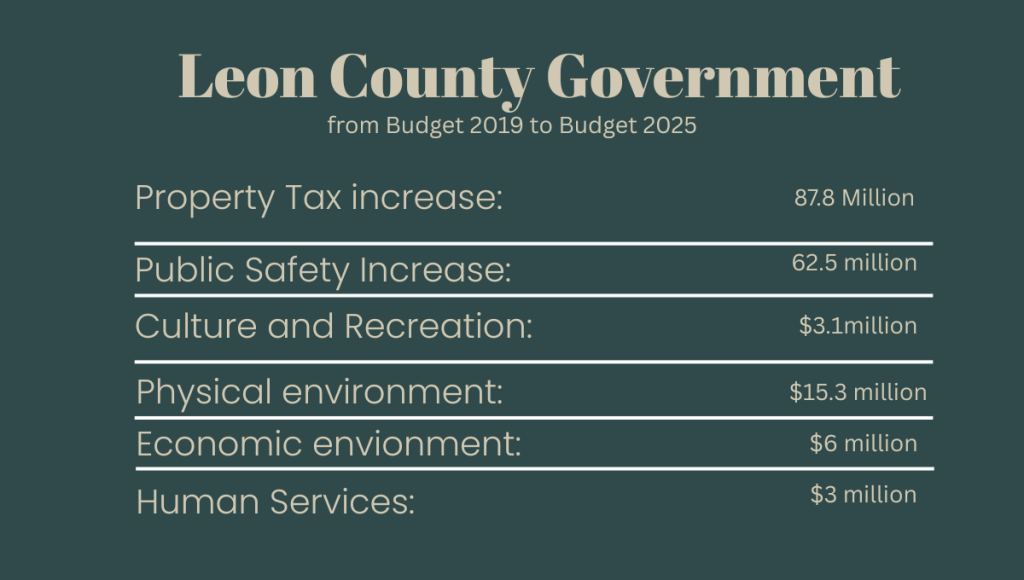
Leon County Government saw an increase in property taxes from $130.8 million in 2019 to $218.6 million. This is an increase of $87.8 million or 67%. At the county commission budget meeting, county staff reported that if the property tax were reduced, they would lose about $72 million.
Public safety saw the majority of that increase in the amount of about $62.5 million or 52.2%. Per the proposed legislation, property tax reduction or elimination will not effect public safety as much as it will affect “Physical environment” which includes conservation and resource management. It might affect “Human services” which include libraries and parks and recreation. This reduction could affect court services or transportation services. “Economic environment” includes programs like veteran services, industry development (the majority of this category), and housing and development.
Fun Fact: Since 2019, the Leon County Government has seen a reduction in debt service of about $1.8 million or 31% reduction. Correlation does not mean causation, but it’s worth noting that John Dailey took office as Mayor of Tallahassee in 2018.
After looking over the list of services that Leon County provides, it is difficult to determine which services should be eliminated. However, we appreciate that in the County’s budget they include an “Executive” line item that is easily identified across all budgets. This item increased by $360,000 since 2019 or 25%. We don’t see this breakdown for executive salaries in OpenGov or the approved budgets for the city.
The Cause of The Symptoms
The City also has its own utility, while the county does not. This reinforces the theory that if we do not address the misspending and instead simply remove one revenue source, the issue will continue and become worse and unchecked.
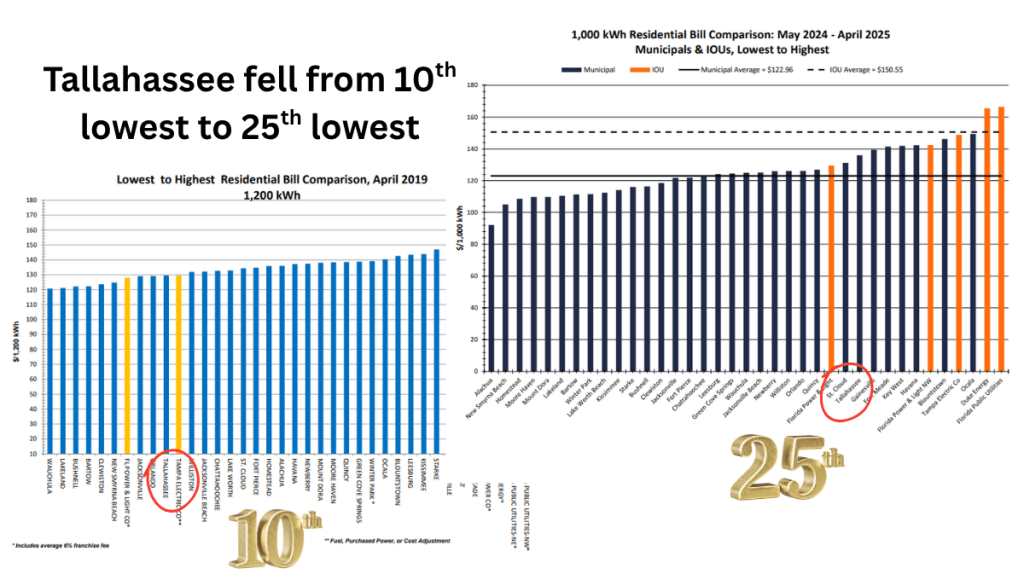
The City’s utility service saw an increase of $50 million since 2019 or a 38.8% increase to our utilities. Our utility rates can and do go up, and we add customer service fees. For our city manager, the benefit of a publicly owned utility isn’t that it’s publicly owned, but that the city controls the bill. Where our city has an opportunity to save our neighbors an expense and create a more affordable city, they instead stall negotiations with our hardworking firefighters, and travel and pay for vanity awards.
During the budget workshop, the city manager said himself (paraphrasing) that he is not as concerned about the property tax reduction as the county. This is because the city has a different revenue source. We do not vote on these increases or the customer charges. A governmental body with no intention of taking a pay cut will more readily exploit fees and surcharges, which lack voter-dependent guardrails, as opposed to the property tax over which we have some semblance of control.
Leon County Sherriff’s Office (LCSO)
While writing this website post, a neighbor requested that our team look into LCSO’s budget as well. It’s important to note that their budget is submitted, approved, and comes from the Leon County government. The Leon County government may reduce the proposed budget and if they do, the sherriff may file an appeal with the state (Florida Statute 30.494).
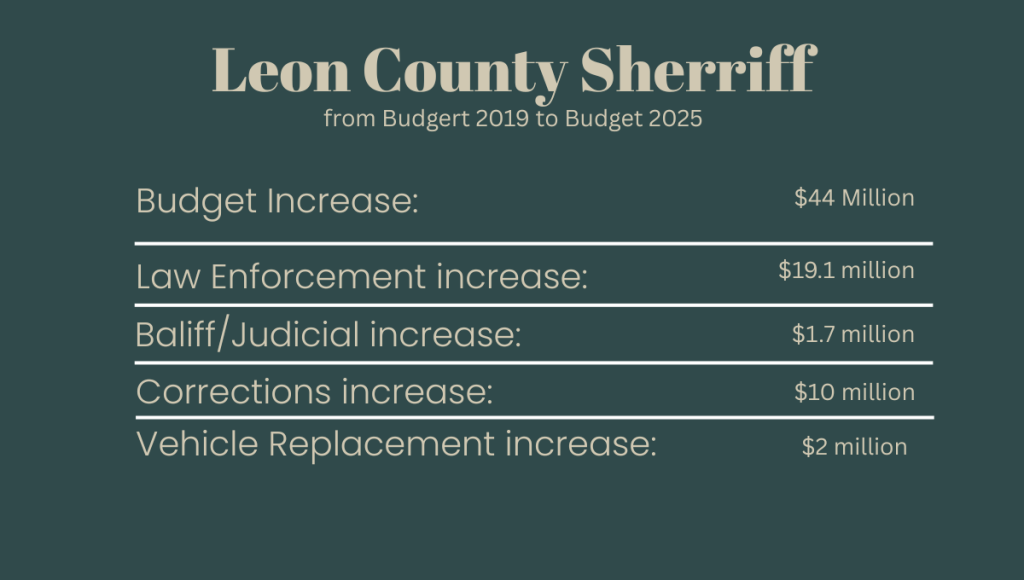
LCSO has also seen an increase its total budget of about $44 million or a 55% increase. The revenue sources here are from the Leon County government as well as from Leon County Schools (LCS) for the school resource officer program.
Fun Fact: LCS was paying more for School Resource Officers (SROs) in 2020 than they currently are. It appears that after a few years in which LCS did not cover the full cost of SROs, LCSO entered into a contract to split the costs. 2020 was ther last year LCS paid more than 50% of the cost.
Diagnosing and Treating the Increase
In medicine, a physician must diagnose the condition to treat the patient. When a physician does not first run tests, assess the patient, and evaluate all information, the patient will continue to experience symptoms with no real relief. The same can be applied to our local governments. The condition our local government is experiencing is mismanagement of our local taxes and public dollars.
The worst thing we can do is create a crisis for our local governments to use as an excuse to not address the condition. The way we address this is to empower our neighbors’ observations of our public spending, ask questions, and make all aspects of government more accessible to our neighbors. We accomplish this through passing legislation that empowers neighbors to make public records requests, report misuse of funds, create accountability through ethics boards, and, when needed, mediation from the state. There are neighbors interested in doing the work, so we must support them. There are neighbors who care about our budgets; we must to elect them and protect their seat when they are up for re-election.
We are better and stronger together. And together we can look at, examine, and identify where our local government is misspending.
- CPI Inflation Calculator, April 2026; https://www.bls.gov/data/inflation_calculator. ↩︎
- OpenGov Budget book, City of Tallahassee April 2026, https://tallahasseefl.opengov.com/transparency/#/56129/accountType=expenses&embed=n&breakdown=types¤tYearAmount=cumulative¤tYearPeriod=years&graph=pie&legendSort=coa&proration=true&saved_view=67254&selection=224453A3A13C2EC4CD90702DA6A9EF4B&projections=null&projectionType=null&highlighting=null&highlightingVariance=null&year=2022&selectedDataSetIndex=null&fiscal_start=earliest&fiscal_end=latest ↩︎
- National Association of Realtors, November 2025 https://www.nar.realtor/press-releases/first-time-home-buyer-share-falls-to-historic-low-of-21-median-age-rises-to-40 ↩︎
- Florida Statutes 30.49 April 2026, https://www.leg.state.fl.us/statutes/index.cfm?App_mode=Display_Statute&URL=0000-0099%2F0030%2FSections%2F0030.49.html ↩︎