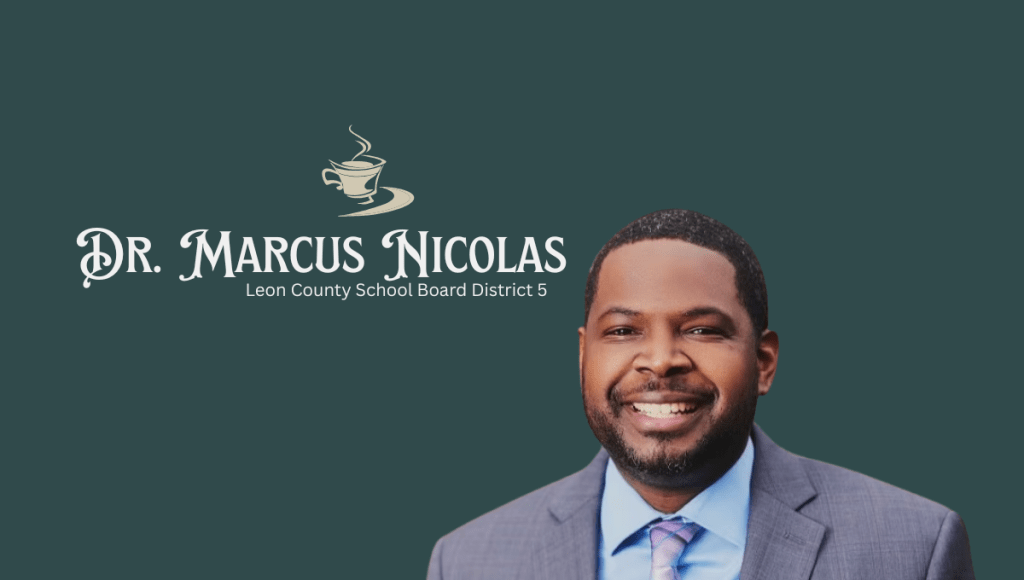
You can visit Dr. Marcus Nicolas on his campaign website HERE. On his website you can easily scroll through information about him, his intentions, and beliefs. If you would like to support him there is also a form to fill out to let him know you would like to volunteer.
Why are you running for school board and what do you plan to accomplish?
I am running for the school board to build on the momentum established during my first term and to continue delivering results for our students, educators, and community.
During my term, I secured over $100,000 in funding for student programs and career readiness opportunities. These initiatives are already making a positive impact, and I am committed to expanding their reach.
I also championed a districtwide compensation study to address pay equity and better align salaries with responsibilities and market conditions. This effort resulted in a comprehensive, multi-year compensation plan to support recruitment and retention, and I will continue working to ensure it is fully implemented.
In addition, I worked to improve budget transparency by advancing clearer financial reporting and tools that help stakeholders better understand how district funds are allocated. Strengthening this process remains a priority.
To address absenteeism, reduce suspensions, and improve classroom environments, I partnered with Florida State University to implement a pilot de-escalation training program for teachers and students. I plan to expand this program across all schools.
Finally, I supported the creation of the district’s first high school College and Career Center, and I will work to extend this model to every high school.
If re-elected, I will focus on expanding successful programs, fully implementing the compensation plan, improving transparency and accountability, and leveraging partnerships to create more opportunities for students.
Many neighbors in our community are feeling distrustful of the school district. How do you plan to rebuild public trust?
Public trust is built through access and clarity, and I have been very intentional about both. My contact information is public, and I regularly meet with residents, whether through phone calls, office visits, or one-on-one conversations over coffee. In recent months in particular, many people have reached out with questions, and I have made myself available to have those conversations directly.
In those conversations, I’ve found that much of the concern comes from not fully understanding how decisions are made or what goes into them. That is why I consistently encourage people to review board materials and ask specific questions about votes and recommendations. It is also why I ask as many questions as I do during the agenda review meetings. Many of those questions are documented in the agenda reviews in BoardDocs, so there is a clear, public record of how decisions are being examined in real time.
Beyond meetings, I have worked to make information more usable, including pushing for clearer financial reporting. In fact, my focus on accessibility and engagement was recognized, in part, through a statewide school board award.
Trust is not rebuilt through statements; it is built through repeated, direct engagement, and that’s what I’ve done.
What specific academic outcomes should the superintendent be accountable for improving over the next 4 years?
This question is most directly aligned with the superintendent’s role as the district’s chief executive officer responsible for implementing academic programs and outcomes (F.S. 1001.49).
The board’s role is to set priorities and ensure accountability for results. In my role, I have focused on key outcomes such as graduation rates and expanding access to industry-recognized credentials.
While the superintendent leads implementation, I work to ensure these priorities are clearly defined, resourced, and consistently reviewed. I have been intentional about elevating academic outcomes as a central part of board discussion, including championing academic data review sessions. Through those sessions, we surfaced that in our district, discipline was not strongly correlated with academic underperformance, while absenteeism showed a much stronger relationship, helping to begin a more focused conversation around attendance.
I have also strengthened the conditions that support improved outcomes by connecting the district with partners like Florida State University and the ASPIRE Capital Region to bring in research, data, and best practices to improve performance. Additionally, I have commissioned both a program audit to ensure alignment with student interest and workforce needs, and an ESE audit to ensure students receiving services are making measurable progress. I have also shared my dissertation research with the district to inform how academic rigor and school environment influence student achievement and decision-making.
School board members do not implement academic programs, but we shape priorities and conditions for success. My focus has been to use data, partnerships, and accountability to ensure those conditions lead to stronger academic outcomes, and our district has seen increases in those priorities. What role should the school board play in reducing absenteeism?
The school board’s role is to establish policy and set the conditions for success (F.S. 1001.41, 1001.42), while the superintendent and district staff are responsible for implementing strategies and managing day-to-day operations. For that reason, absenteeism itself is not directly within the board’s operational responsibilities, but addressing the conditions that contribute to it is.
In my role as a school board member, I have taken an active approach to identifying those contributing conditions and helping position the district to address them effectively. Through discipline data that I commissioned, I identified schools with some of the highest rates of out-of-school suspensions per capita, one of the key factors contributing to absenteeism.
Using that data, I convened researchers from Florida State University, district staff, and school leadership, including the principal at Griffin Middle School, to form a Research Practice Partnership. That collaboration led to the development of classroom de-escalation strategies for both teachers and students.
While I am not responsible for implementation, I worked to initiate the pilot, align the appropriate partners, and ensure the work was grounded in research and data. This pilot now provides a model that can be refined and scaled by the superintendent and district staff.
In addition, I have supported efforts to strengthen student engagement, an important factor connected to attendance, such as the development of career pathway dual enrollment courses. These programs help build persistence, resilience, and communication skills while fostering a greater sense of belonging, which is critical to improving attendance.
Ultimately, absenteeism is influenced by both school-based factors and family engagement. My role is to identify barriers, elevate data-driven solutions, and ensure the district has the policies, partnerships, and conditions necessary to respond effectively.
Many neighbors in our community express an interest in reviewing the budget and expenditures to help reduce spending, do you support allowing them to do this? Why or why not?
I do support community engagement in reviewing the budget, and I have worked to make that engagement more meaningful and accessible. Public school budgets are complex and governed by numerous state statutes and rules, which can make it difficult to identify where flexibility exists.
To address that, I implemented the use of a variance report, which highlights revenue and expenditures that exceed $250,000 and 20% of the budgeted amount, thresholds that are actually lower than standard practice for budgets of our size.
This report is designed to be more user-friendly and is published in BoardDocs, allowing the public to focus on areas where input can be most impactful. It also distinguishes between restricted funds and those with flexibility, so community feedback is directed toward decisions that can realistically be influenced.
My goal has been to move beyond simply providing access to the full budget and instead create clearer, more practical ways for the public to understand and engage with how resources are being used.
What information do you believe the district should make easier for our neighbors to find out without having to dig through board packets?
Board packets are structured intentionally; they function as a comprehensive record where items are sequenced and referenced in a consistent way. Because of that, not every item can be surfaced as a headline without losing that structure.
The more practical question is how we make commonly requested information easier to locate without removing that organization. In my experience, there is a pattern to how items appear in board materials, and once that pattern is understood, information becomes much easier to navigate, similar to a table of contents.
At the same time, we should be focused on what residents are most often trying to find. That typically includes budget summaries, major initiatives, academic performance data, and the rationale behind key decisions. While that information already exists, it is not always surfaced in a way that is intuitive for someone unfamiliar with the system.
Where I have focused my efforts is on making that information more usable. For example, I supported clearer financial reporting through tools like the variance report so the public can more easily identify where changes are occurring. I also use agenda review questions, documented in BoardDocs, to help surface key details and clarify decision points in real time.
Moving forward, the opportunity is to build on that approach by pairing the full record with clearer entry points, such as summaries or dashboards, so residents can access what they are looking for more quickly while still preserving the integrity of the full record.
How will you ensure that you are hearing from all stakeholders outside of district staff and what method will you use to collect this information?
As a public official, accessibility is a core part of my role. My contact information is public, and over the last three years I have consistently engaged with stakeholders through phone calls, emails, direct messages, town halls, and one-on-one meetings.
In practice, that has meant meeting people where they are, whether in formal settings or informal conversations, to better understand their perspectives. I also look for patterns across those conversations to identify broader concerns that may need to be addressed at the board level.
My approach is to remain accessible, responsive, and intentional about listening, so that stakeholder input is not only heard, but reflected in the questions I ask and the decisions I make.
Safe schools are more than protecting our students from weapons and across the county parents report bullying as a major problem. How do you plan to address this in Leon County?
Student discipline and enforcement are operational responsibilities of the superintendent (F.S. 1001.49), while the board establishes the policy framework that guides those actions.
In my role, I have worked to elevate conversations around discipline and ensure that we have clearer, more consistent structures in place. That work contributed to the adoption and strengthening of policies such as Policy 5500, which outlines expectations and consequences related to student behavior, including bullying.
Beyond policy, I have also supported broader conversations around school climate and student supports, including the de-escalation pilot program, recognizing that discipline is not just about consequences but also about prevention and culture.
How do you plan to prioritize capital outlay dollars if you are elected and if the ½ penny is renewed? For clarity, many neighbors feel as though lower safety priority projects have been prioritized over higher safety concerns. Which projects do you feel should be prioritized first and why?
Capital outlay decisions are guided by long-term facility plans, safety needs, and the condition of our schools. As a board, our role is to approve priorities and funding within that framework, while ensuring decisions are data-informed and aligned with student safety and learning environments.
Currently, the district is following a phased approach based on facility age and need. RAA Middle School, one of the oldest in the district, is in phase 2 of construction, with phase 3 planned if the half-penny sales tax is renewed. Following that, renovations are planned for Cobb Middle School and then Godby High School.
When it comes to concerns about prioritization, safety is always a central consideration. At the same time, safety can be addressed in multiple ways, through full campus renovations, targeted improvements, or ongoing maintenance, so priorities are not always defined by a single category.
My focus is to ensure that decisions are based on clear criteria, including facility condition, safety needs, and long-term impact, and that those decisions are transparent and understood by the public. Where concerns are raised, I believe it is important to review the specific projects in question and ensure there is a shared understanding of how priorities were determined.
How do you plan to help support and train new teachers whose background is not the college of education?
Teacher training and professional development are managed by the superintendent and district staff (F.S. 1001.49). The board’s role is to ensure the district has the resources, direction, and partnerships needed to support that work.
Within that role, I have actively supported and encouraged the development of multiple pathways into the teaching profession. This includes para-to-teacher cohort programs through Tallahassee State College and ongoing efforts to create competency-based certification pathways that allow individuals with subject-matter expertise to transition into teaching.
Additionally, I have engaged Tallahassee State College in conversations about establishing an Educator Preparation Institute (EPI) to further expand access and support for aspiring educators.
While I do not train teachers directly, I work to strengthen the pipeline, remove barriers to entry, and ensure that the district is positioned to recruit and support a diverse and capable workforce.
How will you plan to ensure the hiring practices of administrators are fair and consistent? How do you plan to support those placed in those roles?
The board establishes expectations and adopts policies that promote fairness and consistency, while the superintendent is responsible for executing those hiring processes (F.S. 1001.49).
In my role, I led conversations to create more clearly defined administrative procedures for hiring. Prior to that work, the district did not have formally documented administrative procedures in this area. As part of the process, I brought forward language and examples from several other school districts, which helped inform the development and codification of our district’s procedures. This ensured that our approach was both structured and aligned with broader best practices.
Although I am not involved in individual hiring decisions, I see my responsibility as ensuring that the framework guiding those decisions is transparent, equitable, and consistent so the district can implement them effectively.
Many in the community have voiced concerns that most decisions are led by the Superintendent and rubber stamped by the Board. Do you agree with this sentiment? Why or why not? Can you recall a recent decision you disagree with, and what would you have done differently?
The governance structure is designed so that the superintendent brings forward recommendations and the school board takes formal action. As noted in just a handful of examples below, the board does not follow the superintendent’s recommendation and creates its own recommendations.
Within that structure, I review each recommendation carefully, ask questions, and make independent decisions. While some recommendations are ultimately approved, that is often the result of a thorough vetting process, not a default outcome. I do not view my role as simply affirming recommendations, but as evaluating them to ensure they align with the district’s best interests.
There have been several instances where I have voted differently from the superintendent’s recommendation.
A few examples include:
- I did not support issuing a counseling letter to a former HR director.
- I did not support the recommendation to close the virtual school.
- I did not support using Carl Perkins funds to sustain a position. In that case, I offered an alternative funding model that was more sustainable. While I was out voted to proceed with the original recommendation, the district adopted my funding approach the following year.
- I did not support funding a position at Lively due to a lack of clarity in the job responsibilities. I was out voted.
- I did not support funding a district position where the responsibilities were similarly unclear. I was out voted.
- I did not support the original draft of the Addition Financial Affinity contract. My colleagues voted with me and against the superintendent’s recommendation. Because of that, we were able to revisit the agreement and ultimately adopt a more financially favorable contract for the district.
- I did not support the funding of a district position in the attendance office because, at the time, the district had secured the recommendations from the Evergreen compensation study and plan and could have created the new position using the Evergreen framework. I was out voted.
These reflect just a few of my and my colleagues’ dissenting votes. In each case, my decision was based on clarity, sustainability, and alignment with district priorities.
The board’s role is not to rubber stamp decisions, but to provide oversight, ask the necessary questions, and make informed choices. My record reflects a willingness to support recommendations when appropriate and to offer alternatives when improvements are needed.
There is a ballot proposal for a one mil increase to compensate educators, staff, school safety, and essential school programs including arts and athletics, how do you envision that money being distributed? How will you support transparency around these tax dollars as well as other local tax dollars?
The board will ultimately approve the framework for how those funds are distributed, guided by the intent of the ballot, which includes compensation, school safety, and essential programs.
My focus will be to ensure that the distribution is aligned with those priorities and that funding decisions are sustainable, clearly defined, and tied to measurable outcomes.
Because these funds provide increased flexibility to the district, it is equally important that there is strong oversight. That is why the ballot language already includes the creation of a citizen advisory committee to review expenditures, which the board has supported. This ensures that there is an added layer of accountability as these dollars are allocated.
In addition, I will continue to support clear financial reporting, such as the variance report, so the public can easily see how funds are being used and where adjustments are occurring.
Do you have a fiscal plan? If so, what is it and how do you plan to accomplish this plan while working with other board members?
A fiscal plan, in this context, encompasses several areas, including managing expenditures, identifying opportunities to increase revenue, and addressing compensation goals, particularly for positions that currently fall below market averages.
On compensation, I led the conversation around a comprehensive compensation study that reviewed exempt district employees’ salaries against the market. That study revealed that, in several cases, salaries were below market rates. As a result, the district has developed a multi-year plan to address those gaps in a sustainable way. My role has been to elevate that issue, ensure it is data-driven, and keep it a priority in our budget discussions.
In terms of managing expenditures, I have worked to strengthen financial oversight by implementing midyear budget checkpoints through the variance report. This provides a clearer view of where spending is exceeding projections and allows for earlier intervention. In addition, I have supported efforts to review district-operated facilities to identify opportunities for co-location with community organizations. I have personally made introductions to organizations interested in utilizing district space, which can help offset costs and generate additional revenue.
I have also supported revenue-generating strategies. For example, I played a role in negotiating a more favorable affinity contract, which could generate more revenue for the district. I have also encouraged exploring additional opportunities, such as a credit card affinity program similar to the existing debit card program.
Beyond that, I have helped secure more than $100K in external funding and will continue to pursue opportunities, including grant opportunities. As part of that effort, I think the District should explore grant-writing models where compensation is tied to successful awards, creating minimal financial risk for the district. Similarly, I supported the district’s engagement with a student recruitment firm and will be monitoring its effectiveness closely.
While fiscal management is a collective responsibility, my approach is to bring forward data, identify practical strategies, and work collaboratively with other board members to ensure decisions are financially sound, transparent, and aligned with district priorities.
Please tell us one thing about yourself that we would not be able to find through a simple Google search.
N/A